
If AI can generate content, what makes yours worth reading ?
having a clear poin of view that changes everything.

Open LinkedIn on any given day and you’ll see the same thing playing out everywhere …tips, threads, frameworks, hot takes, and a never-ending stream of people who all sound reasonably smart but somehow also sound exactly alike.
You scroll, you read, you maybe even save a post, and then you close the app and move on with your day, carrying almost nothing from what you just read. And the reason for that isn’t what most people want to believe it is.
The problem is that most of what gets published online is information without a real perspective behind it. There is no hook clever enough, no format trendy enough, to make up for the absence of a genuine point of view.
When I started THE CONTENT FRY, I genuinely thought that if my clients showed up consistently and shared useful things, growth would follow. So that’s what we focused on : consistency, volume, different formats, better hooks. And I watched sharp, accomplished founders follow all of that advice carefully and still disappear into the noise. It wasn’t attracting the right people, it wasn’t generating conversations, and honestly, it didn’t feel like it truly belonged to anyone.
That gap between effort and outcome bothered me for a long time, until I finally understood what was actually missing.
A point of view, it turns out, is not something you either have or don’t. It’s not a personality trait. It’s not something reserved for people who are naturally opinionated or who enjoy controversy. It’s something you build, deliberately and over time, and once you understand how it’s built, the whole game changes.
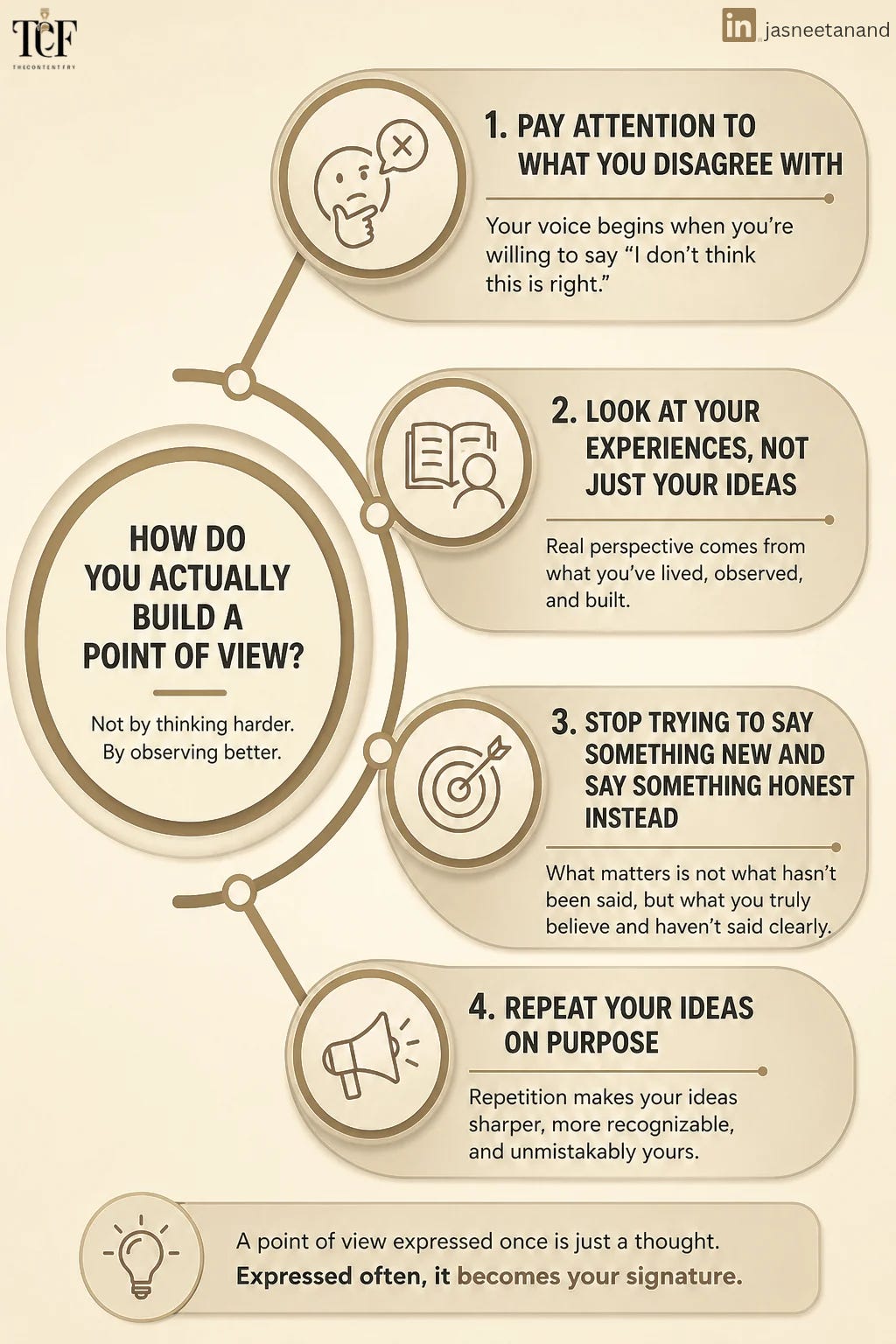
So how do you actually build a point of view?
Not by thinking harder. By observing better.
Most people try to construct a perspective from the outside in, they look at what’s working for others, they study trends, they try to find a gap in the conversation. But a real point of view is built from the inside out, from your own disagreements, your own experiences, and your own honest observations about the world you work in. Here is where it starts:
1. Pay attention to what you disagree with
Most people writing online are trying, consciously or not, to sound agreeable. They share things that feel broadly accepted, things that won’t push anyone away, things that are safe.
And the result is content nobody argues with but also nobody remembers, because there’s nothing to grab onto. Your voice begins at the exact moment you’re willing to say I don’t think this is right.
When reading, if you feel a quiet resistance, a sense that something is off…stop and question why. The honest answer is often the start of a valuable perspective.
For me, that resistance came from watching how the entire conversation around personal branding was built around one idea: just be consistent. And I kept watching that advice fail, because consistency without positioning is just noise with a reliable schedule. That one disagreement became the foundation of everything I do.
2. Look at your experiences, not just your ideas
There is an enormous difference between having an idea and having a perspective, and that difference almost always comes down to whether the thought has a lived experience behind it.
Information is everywhere. What creates a real connection between you and a reader is when they can feel that what you’re saying came from somewhere actual, from something you went through, observed up close, or built with your own hands.
Instead of: Consistency is important for building an audience.
Try: I watched a founder post every single day for three months, generate exactly zero inbound inquiries, and quietly give up and the failure had nothing to do with how often he was showing up.
The stories from your own work, your own mistakes, your own observations from inside your industry are genuinely irreplaceable, and no amount of clever writing or smart strategy can substitute for them.
3. Stop trying to say something new and say something honest instead
There’s a huge pressure in the online writing world to have a take that feels original, to say something nobody has said before, to find the angle that makes your content feel novel.
And that pressure quietly does a lot of damage, because chasing novelty pulls you away from the things you actually know and believe, and pushes you toward performing cleverness instead.
The internet truly does not need another five-letter acronym framework. We are all full. Thank you. :)
The more useful question is not what hasn’t been said yet, but what do I actually believe is true that I haven’t been saying clearly enough.
A simple test: would you say this to a client in a real conversation, without hedging or packaging it carefully? If the answer is no, you’re probably performing and the writing will feel like it.
4. Repeat your ideas on purpose.
Most people are deeply uncomfortable with repeating themselves because it feels like running out of material. But repetition, done well, is one of the most powerful things you can do for your positioning.
It’s how people begin to associate a specific idea with a specific person. A point of view expressed once is just a thought. A point of view expressed across a hundred different contexts : stories, observations, short notes, longer essays becomes something people recognize before they even finish reading the first sentence.
say that in a short note
say it in a long article
say it through a client story
say it as a question that makes someone stop scrolling.
The idea doesn’t get weaker from repetition. It gets sharper, and it starts to feel like it unmistakably belongs to you
.
What this actually looks like in practice?
The shift is simpler than it sounds. Instead of starting every piece of content by asking what should I post today, you start by asking what do I actually believe about this and then you write from that place. It completely changes the texture of what comes out.
Across the 100M+ views we’ve helped generate for clients at The Content Fry, the content that performed best wasn’t the most polished or the most strategically constructed. It was the content that felt the most true.
The real reason your content feels replaceable
Here’s the honest part most writing advice avoids:
If your content feels replaceable, it’s probably not because you lack ideas or intelligence. It’s because you’re not fully saying what you already know. There’s always a gap between what you actually think and what you end up publishing. That gap is where authenticity gets lost.
Most people edit in the direction of safety:
→ soften strong opinions
→ remove anything that feels too direct
→ say it in a way that sounds acceptable
And by the end of it, the content is safe…but forgettable.
Here’s a quick way to check where you stand:
Read back your last five posts. Could any of them have been written by someone else in your industry? If yes, that’s a point-of-view problem, not a quality problem.
Is there anything in your drafts that you’ve been holding back because it feels too direct or too opinionated? That thing is probably your best content.
When you write, are you thinking about what will perform well, or about what you actually believe? The former is a strategy. The latter is a voice.
A point of view isn’t about being loud. It’s about being clear. And clarity doesn’t come from posting more , it comes from paying attention to what you’ve seen, built, questioned, and lived through.
Before you plan your next ten posts
Before you build out a content calendar, try a new format, or spend another hour wondering why the algorithm seems to be ignoring you … take a few minutes and sit with a different question entirely.
Ask yourself: what do I actually believe, about my industry or my work or the people I serve, that I haven’t been saying clearly enough? What’s the thing I keep thinking but have been packaging too carefully, hedging too much, or saving for the right moment that never quite seems to arrive?
That’s the starting point, it’s the foundation that makes everything else worth reading. That’s the difference between content that fills a calendar and content that builds something real and the only thing standing between those two versions is the decision to actually say what you think.
That’s not just content. That’s where people start remembering you.
After my first 3 articles on Substack, I decided to change the whole theme and purpose of starting on Substack. The reason was I felt that nobody would ever want to ready about how I felt away from home, in a new country, became a mother without the “village”. It was basically my point of view that I had decided to share. But somehow after reading the daily notes and topics of articles that I find while scrolling were never about what I had stared to write. I felt I wasn’t writing what people want to read. So now I have a new author note ready to explain my new theme and start afresh. Do you think this is a mistake?
Thanks for this article that made me question my decision of changing the whole purpose of writing.
This is one of those pieces that sounds obvious after reading but isn’t practiced enough. Most people aren’t struggling with ideas, they’re filtering them too much. The line about “you’re not fully saying what you already know” is probably the real problem for most creators. Clarity is harder than creativity, and you’ve captured that well.